
How to Prepare a B2B Marketing Plan for the Future, not the Past
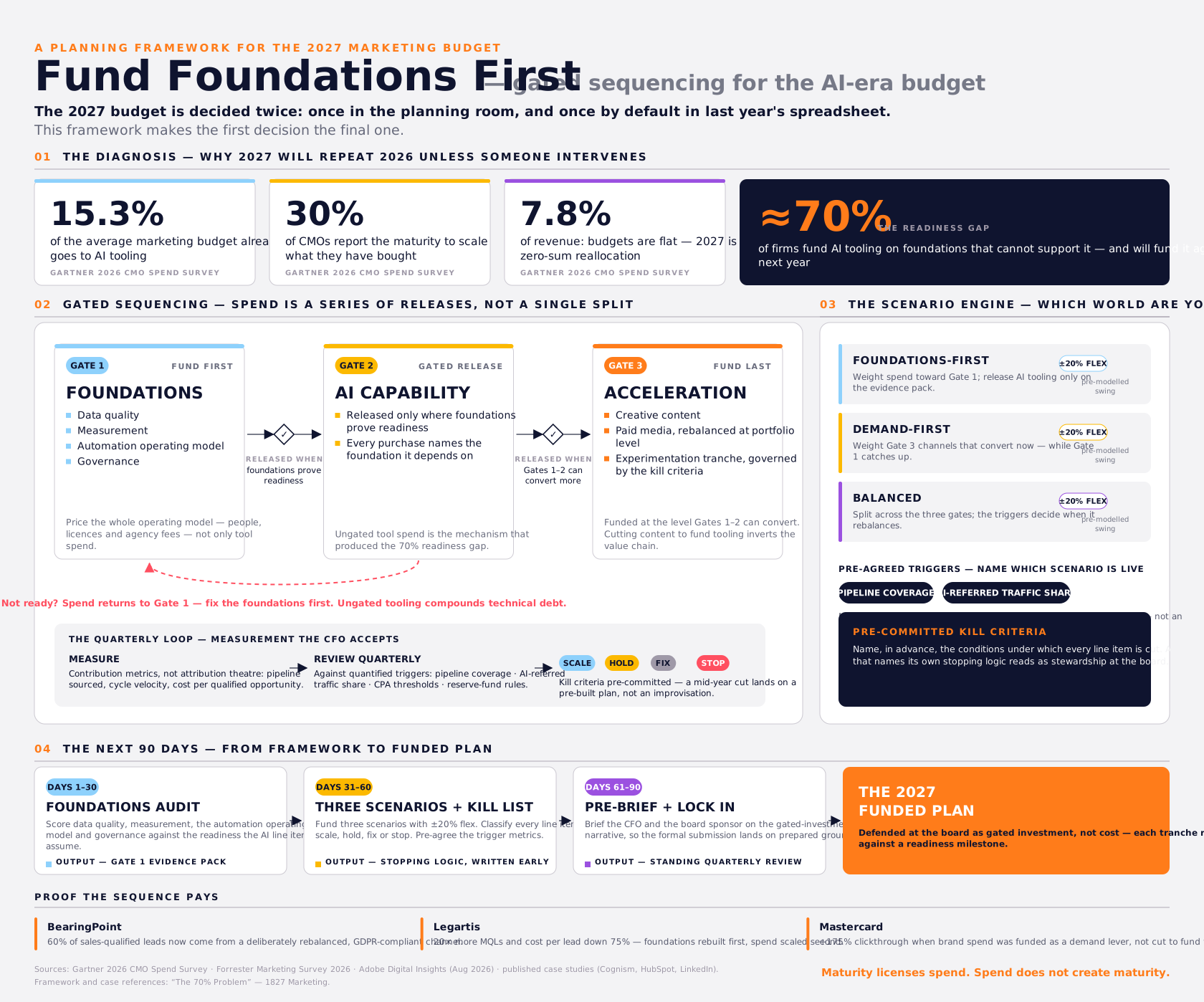
How should a professional services Marketing Director allocate the 2027 marketing budget when AI is disrupting search, buying behaviour and measurement all at once? Gartner’s 2026 CMO Spend Survey shows the AI marketing budget line now absorbs 15.3% of the average marketing budget, while only 30% of CMOs report the maturity to scale it. Read together, those numbers name a harder truth. Roughly 70% of firms are funding AI tooling on foundations that cannot support it, and they will fund it again next year unless someone intervenes.
That intervention is the subject of this article. Budgets sit effectively flat at 7.8% of company revenue, so 2027 is a zero-sum reallocation rather than an expansion.
The direct answer is gated sequencing:
- Fund data, measurement and governance foundations first.
- Release AI tooling only where those foundations prove readiness.
- Then fund creative and paid media at the level the foundations can convert.
Firms that sequence spend this way defend it easily at the board, while firms that fund tools first compound technical debt.
Sign up for our newsletter
Get the latest news and ideas from 1827 Marketing sent directly to your in-box.
You will receive an email from us every couple of months, and you can opt out at any time.
What follows is the evidence, the framework and the language to carry it past the CFO. The place to start is the CRM data quality crisis in professional services, because data is the foundation every other line item quietly assumes.
Frequently Asked Questions (FAQ)
How should a Marketing Director allocate the 2027 marketing budget?
Sequence the budget through three gates rather than a single split. Fund data, measurement and governance foundations first, release AI tooling only where those foundations prove readiness, then fund creative and paid media at the level the first two gates can convert.
What share of the marketing budget now goes to AI?
Gartner’s 2026 CMO Spend Survey finds AI absorbs 15.3% of the average marketing budget, while only 30% of CMOs report the maturity to scale it. The AI-ready minority allocate 21.3% and run budgets of 8.9% of revenue.
Why is baseline drift a risk in 2027 marketing budget planning?
Line items survive because they exist, and platform AI hard-codes last year’s channel mix into this year’s spend through automated bidding. With budgets flat at 7.8% of company revenue, the 2027 plan is decided by default unless a human intervenes.
How is AI changing channel spend in professional services marketing?
Buyers now begin research inside AI assistants, so search-led demand capture loses volume while AI-referred visitors convert better. Adobe reports AI-referred traffic to financial services sites grew 31% year on year, and AI-referred retail visitors converted 60% higher than non-AI traffic.
What measurement convinces a CFO to approve marketing AI spend?
Present the AI line item as gated investment released against readiness milestones, and report contribution metrics the board accepts: pipeline sourced, cycle velocity and cost per qualified opportunity. Pre-committed kill criteria complete the defence by naming each line item’s stopping conditions in advance.
The Diagnosis: 15.3% of Budget, 30% Readiness
Three numbers belong at the centre of the 2027 budget narrative. The Gartner CMO Spend Survey for 2026 finds CMOs allocate an average of 15.3% of marketing budgets to AI, yet only 30% report mature AI readiness. Budgets hold at 7.8% of company revenue. Against most B2B marketing budget benchmarks the average B2B marketing budget is flat, and 56% of CMOs say their organisation lacks the budget to deliver its 2026 strategy.
The 70% readiness gap is a foundations problem. Data quality, measurement, governance and operating model are the constraint. Every pound spent on AI tooling before they exist compounds technical debt rather than capability.
Gartner’s own data proves the point. The AI-ready minority allocate 21.3% to AI and run budgets of 8.9% of revenue, well above the average.
Maturity licenses spend. Spend does not create maturity.
Flat budgets change the planning mathematics. The question is no longer what to add but what to stop, and most marketing organisations have no defensible stopping logic. B2B marketing measurement has not kept pace with adoption, which is why stopping feels impossible. Forrester’s Marketing Survey, 2026 found that 88% of more than 1,000 B2B marketing decision-makers have adopted AI tools, yet leaders report difficulty measuring impact.
Professional services amplifies the cost of getting this wrong. Long sales cycles and committee buying mean misallocated spend surfaces twelve to eighteen months late, when it can no longer be corrected within the planning year. Firms that want marketing attribution built for the AI era build that instrumentation before the budget is set, not after. The same discipline turns AI governance into a commercial advantage rather than a compliance chore.

Why the 2027 Plan Is Already Written (and How to Reclaim It)
The biggest threat to the 2027 budget is last year’s spreadsheet, now automated.
Baseline drift is the silent allocator. Line items survive because they exist. Platform AI hard-codes last year’s channel mix into this year’s spend through automated bidding and budget distribution, unless a human intervenes at the planning level. The marketing budget plan is effectively decided before the planning meeting starts.
AI-mediated discovery is repricing channels on top of that inertia. Buyers now begin research inside AI assistants, so search-led demand capture loses volume while AI-referred visitors convert materially better. Adobe Digital Insights reports that AI-referred traffic to financial services sites grew 31% year on year in July 2026. AI-referred retail visitors converted 60% higher than non-AI traffic. A plan built on legacy search assumptions funds a shrinking pool.
Marketing scenario planning is the defence, because B2B marketing planning fails when it starts from last year’s line items. Fund three scenarios before any negotiation begins: foundations-first, demand-first and balanced.
Give each a pre-modelled flex of plus or minus 20%, so a mid-year cut lands on a pre-built plan rather than an improvised one. Agree the trigger metrics up front, namely pipeline coverage and AI-referred traffic share, so the organisation knows which scenario it is in. The channel logic behind that rebalancing appears in 1827’s work on balancing B2B brand building with AI search optimization.
Case study: BearingPoint reallocates toward a compliant demand channel
BearingPoint, the independent European management and technology consultancy, needed to scale demand across a growing software portfolio. It also had to reach mid-sized organisations that were not yet clients.
The team shifted emphasis toward a data-led, phone-first outbound motion built on verified European contact data, deployed GDPR-compliantly across multiple markets. According to the BearingPoint case study, 60% of all sales-qualified leads now come from that channel. Each sales development representative also saves an estimated six hours per week. The channel-mix shift was deliberate, measured and defended against the previous year’s default.
The Foundations-First Framework: Sequencing the 2027 Budget
Marketing budget allocation works as a series of releases, not a single split:
- Fund Gate 1 foundations first.
- Release Gate 2 AI capability only where foundations prove readiness.
- Then fund Gate 3 acceleration at the level the first two gates can convert.
For B2B marketing budget allocation this sequencing, not the headline percentage, decides whether data and creativity compound or collide.
Gate 1 is foundations. Score data quality, measurement, the automation operating model and governance against the readiness the AI line items assume. Price the whole operating model, including people, licences and agency fees, not only tool spend.
Every Gate 2 purchase should name the foundation it depends on. Ungated tool spend is the mechanism that produced the 70% readiness gap.
The automation operating model is the load-bearing foundation. It is also where marketing automation ROI is decided.Firms with a whole-system view of automation and revenue operations can absorb AI capability. Firms running disconnected tools cannot, regardless of software quality. This is the argument at the heart of 1827’s analysis of why advanced marketing automation fails without high-fidelity content, formalised in the whole-system B2B marketing automation blueprint.
Gate 3 is acceleration, funded at the level the first two gates can convert. Creative content is the asset AI distributes and amplifies, so cutting content to fund tooling inverts the value chain and fails expensively. The experimentation tranche belongs here as a Gate 3 release, governed by the same readiness logic and the kill criteria set out later.
Each gate releases spend against measurable return, and that marketing ROI measurement is the release mechanism.
Case study: Legartis and the return on a foundations-first rebuild
Legartis, a Swiss legal AI company, built its marketing automation foundation before scaling spend. It moved from a CRM base through marketing, sales and operations hubs in sequence.
The discipline produced measurable marketing automation ROI. According to the Legartis case study, the firm increased marketing-qualified leads twenty-fold and improved its MQL-to-SQL conversion rate by 200%. Cost per lead fell by 75%, while inbound marketing grew from 50% to 80% of total marketing. Sequencing, not software, drove the return.

Rebalancing Brand, Demand and Paid Media for AI-Mediated Buying
The prevailing folklore allocates a marketing budget by fixed channel percentages. Roughly a third goes to paid media, a fifth to a quarter to content and SEO, and under a fifth to technology and AI.
That folklore is there to be challenged, not adopted. A professional services marketing budget allocation should follow the scenario, the pipeline coverage and the sales cycle – releasing brand, demand and paid spend through the gates.
- B2B brand building is now shortlist insurance. AI agents and AI answers pre-filter vendor sets, so mental availability and machine-readable authority decide whether a firm is named at all.
- Demand capture cannot recover a brand the machine never surfaced. 1827’s complete AEO strategy for B2B AI visibility sets out how that authority is built.
- Paid media requires a deliberate rebalance, not an autopilot renewal of the digital marketing budget. Platform AI has absorbed the mechanics of media buying, so human planning has moved to portfolio level: which audiences, which buying-group roles, which proof assets.
Over-concentration in one paid channel is an unpriced risk. For most professional services firms that channel is LinkedIn, which is why the disciplined use of LinkedIn Thought Leadership Ads for complex B2B buying groups belongs inside a diversified plan.
Case study: Mastercard funds brand to fuel demand
Mastercard, the New York-headquartered payments technology company, treats brand investment as a demand lever.
Its Asia Pacific communications team ran an always-on campaign built on thought leadership, adding Thought Leadership Ads fronted by six business leaders across Singapore, Australia and India. According to the Mastercard case study, the campaign lifted every key metric year on year. APAC followers rose 130%, clickthrough rate rose 175% and engagement rate rose 169%. Brand spend produced measurable demand-side movement.
Defending the Plan at the Board: Measurement the CFO Will Accept
Marketing measurement is where the 2027 budget defence is won or lost. Present the AI line item as gated investment, not cost. Each tranche releases against a readiness milestone, a governance story a CFO already trusts from other capital processes. Forrester finds 88% of marketing organisations have adopted AI yet struggle to measure its impact, so the director who can say where the AI money goes holds a personal advantage.
Replace attribution theatre with account-level, pipeline-linked marketing effectiveness measurement. The metrics the board accepts are contribution metrics: pipeline sourced, cycle velocity and cost per qualified opportunity.
AI-era measurement requires account-level instrumentation the firm either builds now or defends without later. 1827’s guidance on account-level metrics for AI-era marketing measurement details that architecture.
Pre-commit to the kill criteria. The strongest budget defence names, in advance, the conditions under which each line item is cut. The pre-built scenario flexes from the planning stage make those cuts executable. The kill criteria are marketing ROI measurement made fiduciary.
A plan that names its own stopping logic reads as stewardship, and it governs the Gate 3 experimentation tranche as firmly as any core channel.

The Next 90 Days: From Framework to Funded Plan
This is strategic marketing planning done in 90 days, and the 2027 marketing budget plan is built before the negotiation begins.
Days 1 to 30: run the foundations audit. Score data quality, measurement, the automation operating model and governance against the readiness the AI marketing budget line items assume. The output is the Gate 1 evidence pack.
Days 31 to 60: build the three funded scenarios and the kill list. Classify every existing line item as scale, hold, fix or stop, and write the stopping logic before any negotiation begins. This is B2B marketing planning with pre-agreed triggers, so name the metric that moves the organisation between scenarios.
Days 61 to 90: pre-brief the CFO and the board sponsor on the gated-investment narrative, so the formal submission lands on prepared ground. Convert the kill criteria into a standing quarterly reallocation review with quantified triggers, such as cost-per-acquisition thresholds and reserve-fund rules.
The operational backbone for that cadence is the B2B marketing automation blueprint for the whole system.
The Budget Is Decided Twice
The 2027 budget is decided twice: once in the planning room and once by default in last year’s spreadsheet. The real job is to make the first decision the final one.
Marketing planning that sequences foundations before tools turns the 70% readiness gap from a liability into a moat, because competitors are funding the same tools on weaker ground.
The professional services marketing leaders who act in the next 90 days will defend a budget their boards trust and compound an advantage their peers cannot see. Start with the foundations audit, build the three scenarios and pre-commit the kill criteria. For the operating model that carries the plan, see 1827’s whole-system approach to B2B marketing automation and creative content delivery.
Have a B2B marketing project in mind?
We might be just what you’re looking for


